Expand Child Care Workforce
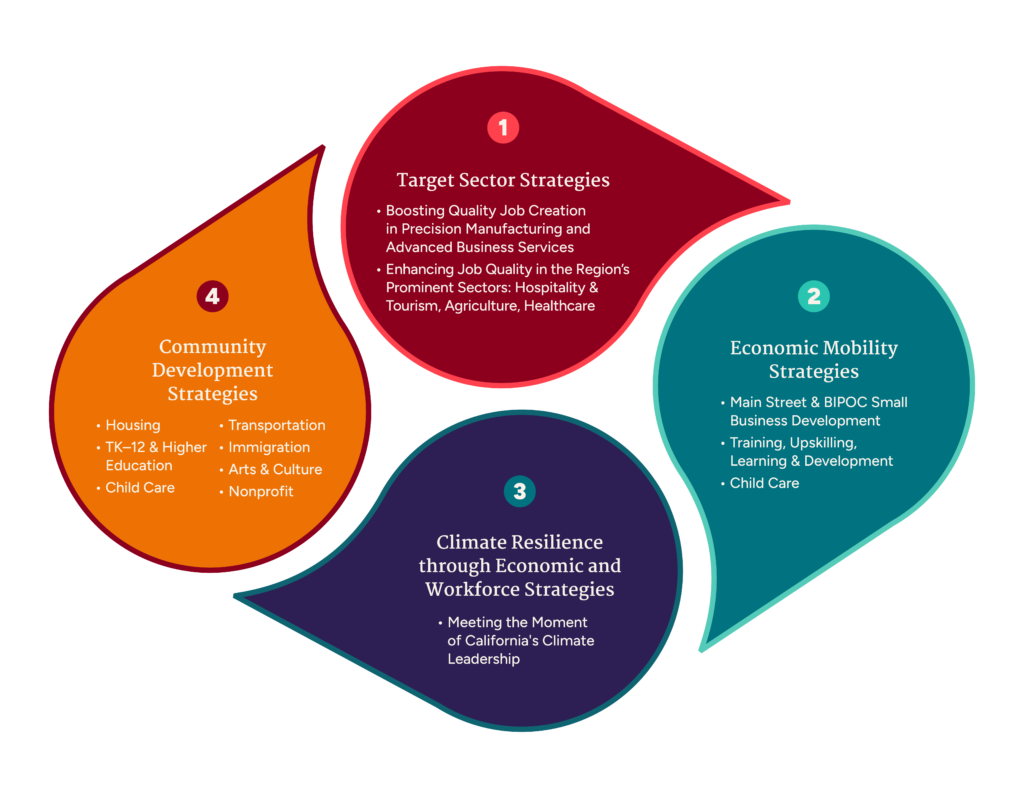
The Central Coast needs more people who are well compensated for the child care that they provide. Many center-based programs across the region are operating at reduced capacity due to the lack of a workforce. Increasing the region’s base of child care providers could help make the child care system, and therefore the economy, more resilient. Apprenticeship programs, such as those offered by Hartnell’s Campus Child Development Center, could be scaled to train a more robust child care and early childhood education workforce. When child care providers are suddenly unavailable, caregivers of young children, often mothers, can be forced to take time off from work. Creating a network of substitute child care providers who can fill in during these times can help avoid workforce disruption disproportionately impacting women. Expanding the child care workforce can create more job opportunities, especially for women, immigrants, and Black, Indigenous, and People of Color. This approach not only meets a critical community need but also equitably increases access to employment, benefiting both the regional economy and its residents. This aligns with state strategies, such as the Unified Strategic Workforce Development Plan, as well as Uplift’s North Star.
Enhance Child Care Infrastructure
Meeting the child care needs of Central Coast residents requires more space for child care to occur, whether that be in a center or a home. However, the cost of building, leasing, and permitting is prohibitively high, the permitting process can take a long time, and building code compliance can be difficult. Barriers for establishing a home-based child care are high as well. Additionally, without physical space for child care to occur, government funding for affordable child care cannot be fully used. Providing discounted child care fails to aid families when there are too few available spots or when it is completely unavailable. Tactics such as awarding grants for child care business startups, waiving development fees and expediting permitting for Accessory Dwelling Units (ADUs), housing construction or retrofits, and other buildings that incorporate or support dedicated spaces for child care may facilitate development. Partnering with faith-based organizations and making the most of under-utilizing spaces may be another option to find additional locations for child care. Enhancing child care infrastructure advances economic diversification and resilience by increasing availability of child care. Adequate space to provide child care is critical for increasing capacity and giving families quality options so caretakers of young children can more easily participate in the workforce. Increasing the supply of child care may also reduce the distance required to drive to and from the child care site, which will reduce greenhouse emissions in alignment with the state’s carbon neutrality goals and strategies such as the California Climate Scoping Plan.
Encourage Employer Supported Child Care
Uplift encourages programs for employers to provide optional child care for employees through on-site or near-site child care, employer collaboratives, stipends (e.g., cash assistance), employer subsidies, employer contributions to flexible dependent care spending accounts, or first right of access to increase the feasibility of caretakers of young children participating in the workforce, therefore advancing economic diversification and resilience. Over 75 percent of respondents to Uplift’s Public Opinion Poll think that it is very important to prioritize employers that provide exceptional benefits, including child care, with 75.5 percent indicating that as “very important,” 19.2 percent indicating that as somewhat important, and 5.1 percent indicating that as “not important.” Providing child care on site could eliminate extra driving, reducing greenhouse emissions in alignment with the state’s carbon neutrality goals and strategies such as the California Climate Scoping Plan. Furthermore, employers may expand family-friendly business practices such as robust paid family leave, virtual work, welcoming infants-at-work, flexible scheduling, and accommodations that could reduce burdens to families and the whole child care system.
Improve Usability of Centralized Resources to Navigate the Child Care System
Even with Child Care Resource and Referral (R&R) Agencies in each county, the very limited child care on the Central Coast is difficult to navigate. With a variety of voucher programs, waiting lists, and requirements, it can be overwhelming to know where to begin. From home-based care to center-based care, caretakers of young children may also struggle to discern which options are preferred for their families. English-only resources, standard business hours, and inaccessibility can significantly complicate the child care search for families who speak languages other than English, work non-standard hours, or have children with specialized care needs. Expanding resources and outreach for and the enhancing usability of a consolidated place – which can have online and in-person resources - for information about child care options could help reduce this burden for the community. This effort could be supplemented with programs for outreach to disinvested communities to access culturally informed and affordable child care. Outreach may be conducted by paid, trusted messengers like promotoras to conduct door-to-door outreach to families on the availability of affordable child care. Providing such resources may empower families with the information required to simplify their experience navigating the child care system, increasing enrollment in support programs from disinvested communities.